The digital divide is no longer about who has access to the internet; it is about where the internet ends and reality begins. As we move through 2026, two tectonic shifts in technology are colliding to create a world where data is no longer something we look at on a screen, but something we inhabit. The race for 6G connectivity and the maturity of spatial computing are the twin engines driving this transformation.
By the end of this decade, the concept of “going online” will feel as antiquated as “dialing a phone.” Instead, we will exist in a persistent, data-rich environment where the physical and digital are indistinguishable.
The 6G Backbone: More Than Just “Faster 5G”
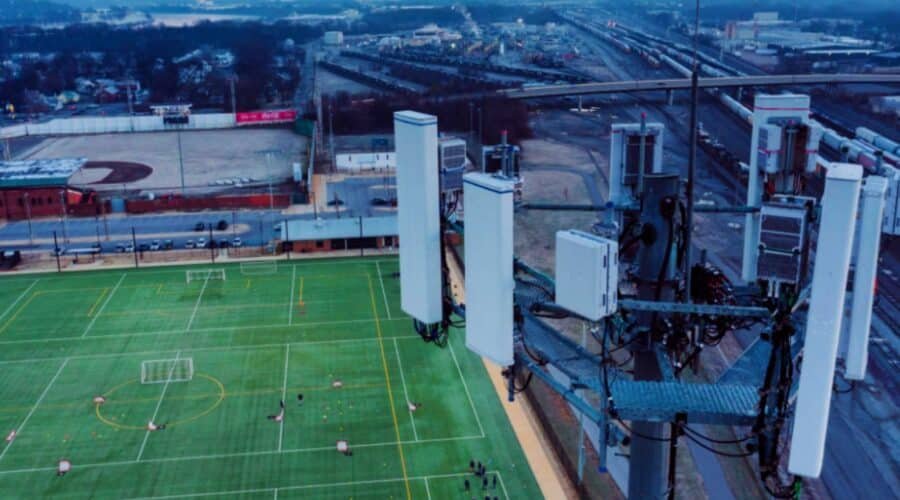
While 5G focused on connecting everyone to everything, 6G is designed to create a “ubiquitous intelligence” network. In 2026, the race for 6G supremacy between the U.S., China, and the EU has moved from the laboratory to the stratosphere.
Terahertz Frequencies
6G utilizes THz frequencies to provide speeds up to 100 times faster than 5G, enabling the instantaneous transfer of massive 3D data sets.
Sub-Millisecond Latency
With latency dropped to near-zero (under 0.1ms), the “lag” that causes motion sickness in virtual environments is eliminated, allowing for perfect synchronization between human movement and digital response.
Sensing as a Service
Unlike previous generations, 6G networks can “see” and “sense” the environment, acting like a giant radar system that tracks the position of people and objects with sub-centimeter accuracy.
Spatial Computing: The Interface of the Future
If 6G is the nervous system of this new reality, spatial computing is the eyes and ears. Spatial computing refers to the ability of machines to understand the physical world—geometry, lighting, and persistence—and overlay digital information onto it.
Devices like the latest lightweight AR glasses and advanced MR (Mixed Reality) headsets have transitioned from gaming novelties to essential productivity tools. We are moving from a 2D Internet (scrolling on glass) to a 3D Spatial Web (interacting in space).
The Synergy: Why Spatial Computing Needs 6G
Spatial computing cannot reach its full potential on 5G or Wi-Fi alone. To render a photorealistic 3D hologram of a person in your living room in real-time, the device needs to process gigabytes of data every second.
Distributed Computing
6G allows the heavy lifting of graphics processing to be done at the “edge” of the network rather than on the headset itself. This is why AR glasses in 2026 are becoming as light as standard Ray-Bans—they no longer need massive batteries or processors.
Holographic Communication
6G’s bandwidth makes high-fidelity “Holoportation” possible. Remote meetings are no longer a grid of faces on Zoom; they are a circle of volumetric avatars sitting around your actual office table.
The Tactile Internet
Combined with 6G, spatial computing enables haptic feedback over the air. You can “feel” the texture of a digital fabric or the resistance of a virtual dial, merging the sense of touch across distances.
Industry Impacts: The Real-World Application
The merging of these realities is revolutionizing how we work, learn, and heal.
Healthcare and Remote Surgery
The sub-centimeter accuracy of 6G allows a specialist in London to perform surgery on a patient in a rural Indian village using robotic arms and a spatial interface. The surgeon “sees” the patient’s internal organs overlaid with real-time diagnostic data, ensuring a level of precision previously impossible.
Manufacturing and Digital Twins
Factories are now built as “Digital Twins.” Every machine on the floor has a digital counterpart in the spatial web. Using AR glasses, engineers can see the “health” of a machine—temperature, torque, and maintenance history—floating right above the hardware. They can even simulate a repair in the digital space before touching the physical machine.
Education and Immersive Learning
History students in 2026 don’t just read about Ancient Rome; they walk through it. 6G-powered spatial computing allows entire classrooms to enter a persistent historical simulation where every student can interact with the environment and each other simultaneously.
The Ethical and Privacy Frontier
As our physical and digital realities merge, the stakes for privacy have never been higher. When a 6G network can sense your heartbeat and your AR glasses map your private home, data security becomes a matter of physical safety.
Spatial Privacy
We will need new laws to govern who can “place” a digital object in a physical space you own.
Biometric Security
As our bodies become the interface, protecting biometric data from “spatial hacking” is the next great cybersecurity challenge.
Conclusion: The Dawn of the “Omniverse”
The 6G race is not just a competition for better downloads; it is a race to define the infrastructure of human existence. As spatial computing becomes the primary way we interact with information, the physical world will become a canvas for our digital imagination. We are standing at the threshold of the “Omniverse”—a unified reality where distance is irrelevant and information is atmospheric. For businesses and creators, the message is clear: stop thinking in 2D. The future is spatial, and it’s arriving at the speed of 6G.