The dust from the 2024 general elections has barely settled, but in the world of Indian politics, the machinery never truly stops. As we navigate through the year, the political corridors in New Delhi and state capitals are already buzzing with anticipation for the India elections 2026.
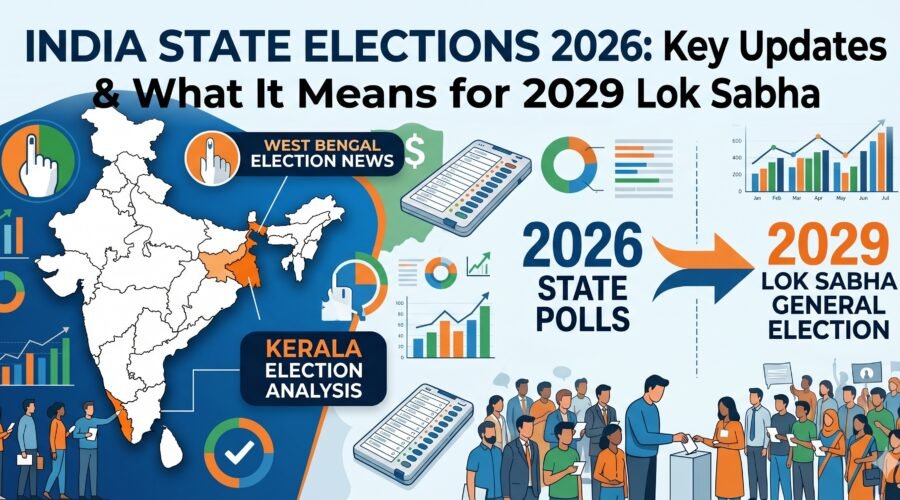
Often dubbed the “semi-finals” before the ultimate showdown, the 2026 assembly polls will see crucial states like West Bengal, Kerala, Tamil Nadu, and Assam heading to the ballot box. These aren’t just regional skirmishes; they are massive ideological battles that will set the narrative, test the strength of political alliances, and significantly impact the road to the 2029 Lok Sabha elections.
Whether you are a political junkie, a policy analyst, or a voter trying to make sense of the shifting tides, understanding these upcoming state polls is critical. Let’s dive deep into the latest developments, the major parties at play, emerging voter trends, and how the outcomes will shape the future of national politics.
The Stakes: Why the 2026 Elections Matter So Much
To understand the gravity of the 2026 assembly elections, you have to look beyond the Chief Ministerial chairs. State elections directly dictate the composition of the Rajya Sabha (the Upper House of Parliament). For any ruling coalition at the center, having favorable numbers in the Rajya Sabha is essential for passing crucial, often contentious, national legislation smoothly.
Furthermore, these elections will serve as a litmus test for the opposition bloc. Can regional heavyweights hold their turf against national juggernauts? Will local anti-incumbency overshadow national narratives? The states going to polls in 2026 account for a massive chunk of Lok Sabha seats, making this electoral cycle a perfect barometer for the national mood.
Let’s break down the specific battlegrounds dominating the headlines.
The Eastern Fortress: West Bengal Election News and Strategies
If there is one state that promises high-octane political drama, it is West Bengal. The fierce rivalry between the ruling Trinamool Congress (TMC) and the Bharatiya Janata Party (BJP) is expected to reach a fever pitch.
Anyone following the latest West Bengal election news knows that the state is currently a cauldron of complex socio-political dynamics. The TMC, led by Mamata Banerjee, is fighting to protect its stronghold against a highly aggressive BJP machinery that has been steadily expanding its grassroots footprint over the last decade.
Key Developments in Bengal
The Welfare vs. Anti-Corruption Narrative
The TMC is relying heavily on its deeply entrenched welfare schemes, particularly those aimed at women voters, such as the Lakshmir Bhandar scheme. However, the party is also battling severe anti-incumbency and continuous allegations of corruption at the panchayat and state levels.
The BJP’s Push
The BJP is expected to capitalize on these corruption allegations, focusing heavily on issues of law and order, transparent governance, and national integration.
The Left-Congress Alliance
The traditional Left-Congress alliance is desperately trying to reclaim its lost relevance. While they may struggle to form a government, their ability to cut into the vote shares of either the TMC or the BJP could end up deciding the final outcome in several tight constituencies.
Shifting Tides: A Deep Dive Kerala Election Analysis
Down south, the political landscape is entirely different, yet equally riveting. Kerala has historically swung like a pendulum between the Communist Party of India (Marxist)-led Left Democratic Front (LDF) and the Congress-led United Democratic Front (UDF). However, recent years have shown that the traditional bipolar contest is slowly fracturing.
A thorough Kerala election analysis reveals a subtle but significant undercurrent: the growing presence of the NDA.
What to Watch in Kerala
Breaking the Alternation Trend
In 2021, Pinarayi Vijayan’s LDF broke a four-decade-old trend by winning a consecutive second term. The question now is whether the UDF can bounce back strongly, capitalizing on any administrative fatigue or economic concerns facing the current government.
The BJP’s Strategic Inroads
The BJP has historically struggled to win assembly seats in Kerala, but their vote share has been steadily creeping up. By courting specific demographic segments, including certain Christian communities and urban middle-class voters, the BJP is aiming to transition from a “vote-cutter” to a serious contender in select pockets.
Economic Pressures
Kerala relies heavily on remittances and faces unique fiscal challenges. Unemployment, state debt, and the exodus of youth for higher education and jobs will be major talking points on the campaign trail.
Expanding the Map: Tamil Nadu and Assam
While Bengal and Kerala often steal the spotlight, the 2026 cycle also includes Tamil Nadu and Assam—states with massive political weight.
- Tamil Nadu: The ruling DMK, under MK Stalin, will look to defend its fortress against the AIADMK and an increasingly vocal state BJP unit. Dravidian politics, state autonomy, and language identity will remain front and center.
- Assam: In the northeast, the BJP, led by Himanta Biswa Sarma, will aim to retain power by heavily emphasizing infrastructural development, indigenous rights, and strong border security narratives, while the opposition attempts to consolidate minority votes and highlight regional grievances.
Emerging Voter Trends to Watch
As we inch closer to 2026, political analysts are observing several distinct voter trends that could redefine campaign playbooks:
The Silent Force of Women Voters
Across India, women have emerged as a highly independent and decisive voting bloc. From Bengal’s direct cash transfers to tailored welfare initiatives in southern states, political parties are crafting manifestos specifically designed to woo the female electorate. In many recent elections, women’s turnout has surpassed men’s, making them the ultimate kingmakers.
The Youth and Employment Crisis
India’s massive youth demographic is increasingly restless. While emotional and ideological appeals still work, there is a tangible shift toward demanding concrete answers on job creation, exam paper leaks, and economic stability. Parties that can successfully project themselves as the champions of economic upward mobility will have a distinct advantage.
Hyper-Local Over National Issues
While national elections often ride on massive waves of leadership or security narratives, state elections are deeply rooted in the mundane. Road quality, local school infrastructure, drinking water, and the accessibility of local MLAs tend to heavily outweigh macro-level ideological debates in the minds of the state voter.
The Ultimate Impact: What It Means for the 2029 Lok Sabha
You might be asking: Why should someone care about state polls when the next Prime Ministerial race isn’t until 2029? Think of politics as a game of momentum. The results of the India elections 2026 will set the psychological and mathematical groundwork for 2029.
Testing the Opposition’s Unity
If the national opposition alliance can successfully coordinate seat-sharing and defeat the ruling national party in states like West Bengal and Assam, it will provide massive adhesive to keep their coalition intact for 2029. Conversely, infighting and subsequent losses in these states could fracture the opposition irreparably.
Narrative Building for 2029
A sweep in these states by the NDA would validate their national policies and provide incredible momentum, making their 2029 campaign look like a foregone conclusion to the average voter. However, if regional parties hold their ground or expand, it forces the national discourse back to a state-by-state battle, complicating the path to a clear parliamentary majority.
The Rajya Sabha Equation
As mentioned earlier, the immediate practical impact of the 2026 elections is legislative power. A shift in state assemblies means a shift in the Rajya Sabha by 2027 and 2028. For the national government to pass ambitious, sweeping reforms before the end of their term, they need the numbers that these state MLAs will eventually vote to send to the Upper House.
Conclusion
The 2026 state assembly elections are shaping up to be a defining moment in modern Indian political history. From the grassroots battles in Bengal to the ideological shifts in Kerala, the outcomes will echo far beyond state borders. Politicians are already sketching their battle plans, and voters are quietly evaluating their options.