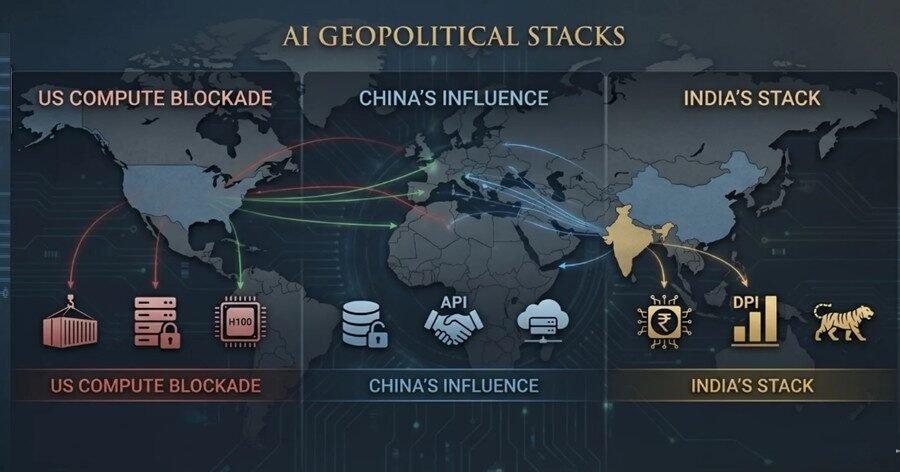
The year 2026 has solidified a new global reality: Artificial Intelligence is the primary currency of national power. The era of “AI Geopolitics” has transitioned from theoretical policy papers to a high-stakes, real-world race where the United States, China, and a rapidly surging India are fighting for control over the foundational layers of modern civilization.
This isn’t just about faster chatbots or smarter algorithms. In 2026, the race centers on “Sovereign AI”—the ability of a nation to own its compute, data, and models without being structurally dependent on a rival power.
The United States: Maximum Lethality and Computational Dominance
The U.S. enters 2026 maintaining a massive lead in raw computational power. By early 2025, the U.S. already accounted for a vast majority of global AI supercomputer performance, leaving rivals to bridge a widening gap.
Technological Implication
The U.S. strategy is built on the “Hyper-Scaler” model. Giants like NVIDIA, Microsoft, and OpenAI have established a proprietary “walled garden” of frontier models. Washington’s 2026 policy focuses on Export Diplomacy, signing AI partnerships with strategic allies to ensure the world builds on American-developed code.
Military Implication
2026 has seen the first large-scale field test of AI-integrated warfare. Under “Operation Epic Fury,” AI systems have compressed the “kill chain”—the time from identifying a target to striking it—from days to mere seconds. The U.S. “AI Acceleration Plan” is now treating AI adoption as an operational race, prioritizing speed and “diffusion” across every branch of the military.
China: The “Predictive State” and Open-Source Influence
While the U.S. dominates proprietary models, China has executed a masterful pivot toward Open-Source Leadership. By 2026, Chinese models have become the “Android of AI,” providing free, high-performance alternatives to the Global South.
Economic Implication
China is not just building AI; it is embedding it into the “National Architecture.” Through the “AI+” initiative, Beijing has automated its logistics and urban management, aiming to capture a massive global humanoid robot market to offset its shrinking workforce.
The Predictive State
China’s 2026 governance model is moving from reactive to predictive. By integrating digital identity, sensors, and payments, the state uses AI to preempt social and financial instability before it occurs. This “Full-Stack” approach ensures that even if they lag in raw chip performance due to international sanctions, their integration of AI into daily life remains a global benchmark.
India: The Pivotal Middle Power and Semiconductor Surge
2026 marks the year India moved from an “emerging” AI player to a “pivotal” one. India has successfully avoided being locked into either a U.S. or Chinese “stack,” instead building its own Digital Public Infrastructure (DPI).
Semiconductor Sovereignty
With the launch of Semiconductor Mission 2.0, India has approved several major fabrication plants. The goal is clear: become a top-five global chip hub by 2030. By manufacturing the hardware locally, India is securing its AI future against global supply chain shocks.
The India AI Mission
Under this flagship project, tens of thousands of GPUs have been deployed for local startups and researchers. India’s 2026 strategy focuses on “Responsible Scaling,” positioning the country as the global leader in AI ethics and data governance for the Global South.
The “Chip Wars” and the 2026 Stalemate
The battleground for these three powers remains the silicon chip. International export controls on high-end processing units have forced China to indigenize. As of 2026, domestic Chinese chips now make up a significant portion of their internal market, up from near zero just five years ago.
Meanwhile, India is positioning itself as the “neutral ground” for manufacturing, attracting billions in investment from global tech giants who want to diversify their production away from traditional hubs.
Technological & Military Risks
The race has created a “Valuation Gap” and significant risks:
AI Poisoning
As nations fight for data dominance, “AI poisoning”—the deliberate feeding of corrupt data to a rival’s model—has become a tool of electronic warfare.
Automation Bias
In military settings, the pressure for “strike efficiency” is leading to a dangerous reliance on AI recommendations, often sidelining human judgment in life-or-death decisions.
Conclusion: A Multipolar Intelligence Order
The global landscape of 2026 suggests that AI is no longer just a technological tool, but the ultimate arbiter of national sovereignty. As the United States doubles down on frontier innovation and military lethality, and China perfects the integration of a predictive, automated state, India has carved out a critical third path by securing its hardware through the Semiconductor Mission and its data through independent digital infrastructure. The resulting multi-polar order has replaced the dream of global AI cooperation with a reality of “Intelligence Blocs,” where a nation’s power is measured by its ability to compute, innovate, and remain technologically self-reliant in an increasingly fractured world.