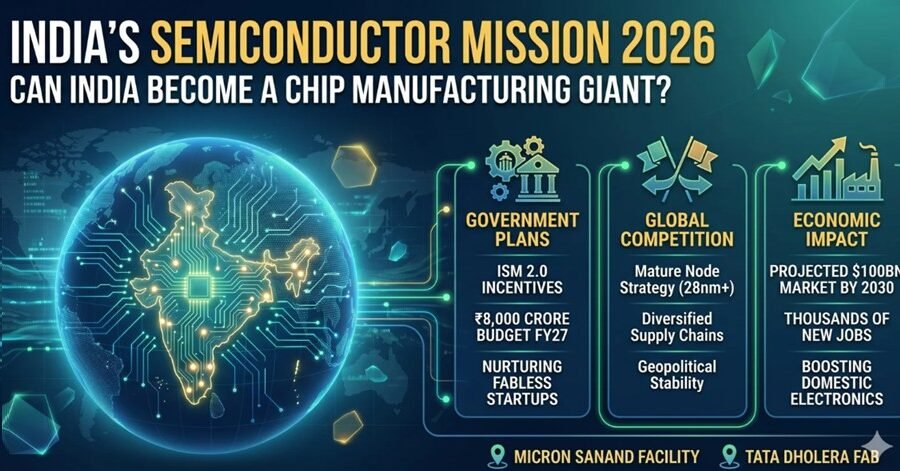
In the high-stakes game of global technology, 2026 is rapidly shaping up to be a watershed year for India. For decades, the country has been a massive consumer of microchips and a hub for software talent. Today, it is aggressively pivoting to become a physical pillar of the global semiconductor supply chain. With commercial production officially underway at early sites and massive fabrication plants halfway built, the question is no longer if India can manufacture chips, but how big of a giant it will become.
Driven by the ambitious India Semiconductor Mission (ISM), the nation’s transition from policy formulation to production readiness is moving at breakneck speed. Here is a look at the government roadmaps, the intense global competition, and the profound economic impact of India’s silicon dream.
Government Plans: The Rise of ISM 2.0
The foundation of India’s current momentum was laid by the ₹76,000 crore incentive framework of ISM 1.0. As of late 2025, the government had successfully approved 10 major projects worth ₹1.60 lakh crore across six states.
In 2026, the strategy evolved. The Union Budget 2026–27 introduced ISM 2.0, signaling a critical shift from merely attracting assembly plants to establishing deep, native technological sovereignty.
Budgetary Push
The Modified Programme for Development of Semiconductor and Display Manufacturing Ecosystem was granted a massive financial outlay of ₹8,000 crore for FY 2026–27 alone.
Expanding the Scope
While ISM 1.0 focused heavily on fabrication, assembly, and testing (ATMP/OSAT), ISM 2.0 is designed to build a full-stack ecosystem. The focus has expanded to domestic production of semiconductor equipment and specialty materials, as well as designing Indian semiconductor Intellectual Property (IP).
Design-Linked Incentive (DLI) Success
The government is nurturing the fabless ecosystem, supporting dozens of semiconductor design startups that have already successfully fabricated chips at advanced foundry nodes.
Ground Reality: From Blueprints to Silicon in 2026
The true test of any manufacturing policy is execution. In Q1 2026, India delivered two monumental milestones that proved its capability to the world:
Micron’s Sanand Facility Goes Live
Prime Minister Narendra Modi inaugurated Micron Technology’s $2.75 billion Assembly, Test, Marking, and Packaging (ATMP) facility in Sanand, Gujarat. Astoundingly, this facility went from the signing of an MoU to commercial production in just 900 days. The plant has already begun shipping its first made-in-India memory modules to global clients, cementing India’s status as a functional chip exporter.
Tata’s Dholera Fab Hits the Halfway Mark
The Tata Electronics and Powerchip Semiconductor Manufacturing Corporation (PSMC) joint venture in Dholera, Gujarat, reached 50% construction completion. As India’s first AI-enabled commercial fabrication plant, this massive 66-hectare Special Economic Zone (SEZ) is on track for trial production by late 2026.
The Global Competition
India is entering a fiercely competitive arena. The United States, the European Union, Japan, and China are all pouring hundreds of billions of dollars into semiconductor self-reliance. Meanwhile, Taiwan and South Korea remain the undisputed kings of advanced nodes.
So, how does India compete?
Strategic Niche
Rather than directly fighting Taiwan for the bleeding-edge sub-3nm market, India is smartly targeting mature nodes (28nm and above). These “legacy chips” are the unsung heroes powering automobiles, telecommunications, defense systems, and consumer electronics—sectors experiencing explosive demand.
The “China Plus One” Beneficiary
Global tech giants are desperate to diversify their supply chains away from geopolitical flashpoints. India offers geopolitical stability, a massive domestic market, and heavy fiscal support.
Speed and Scale
Historically plagued by bureaucratic red tape, the Indian government’s expedited approvals and rapid infrastructure development—exemplified by the 900-day turnaround of the Micron plant—are actively shifting global perceptions.
The Economic Impact
The ripple effects of India’s semiconductor mission will reshape its macroeconomic landscape over the next decade:
Market Growth
Industry estimates project the Indian semiconductor market to explode to $100–$110 billion by 2030.
Job Creation
Semiconductor manufacturing is a powerful employment engine. The Tata Dholera SEZ alone is projected to create 21,000 jobs, while the Micron facility will generate upwards of 5,000 direct roles and roughly 15,000 indirect community jobs.
Catalyzing Downstream Industries
A domestic supply of chips lowers the cost and supply chain risks for India’s burgeoning electronics manufacturing sector. From electric vehicles (EVs) to smartphones and AI data centers, having localized silicon turns domestic manufacturing into a highly competitive global reality.
Conclusion
Can India become a chip manufacturing giant? The events of 2026 suggest a resounding yes. While it may take years to match the advanced fabrication capabilities of industry veterans like Taiwan, India has successfully broken through the hardest barrier: starting. With commercial tape-outs happening, billion-dollar factories going live, and a clear, well-funded roadmap in ISM 2.0, India is no longer waiting for the future of technology—it is actively manufacturing it.